
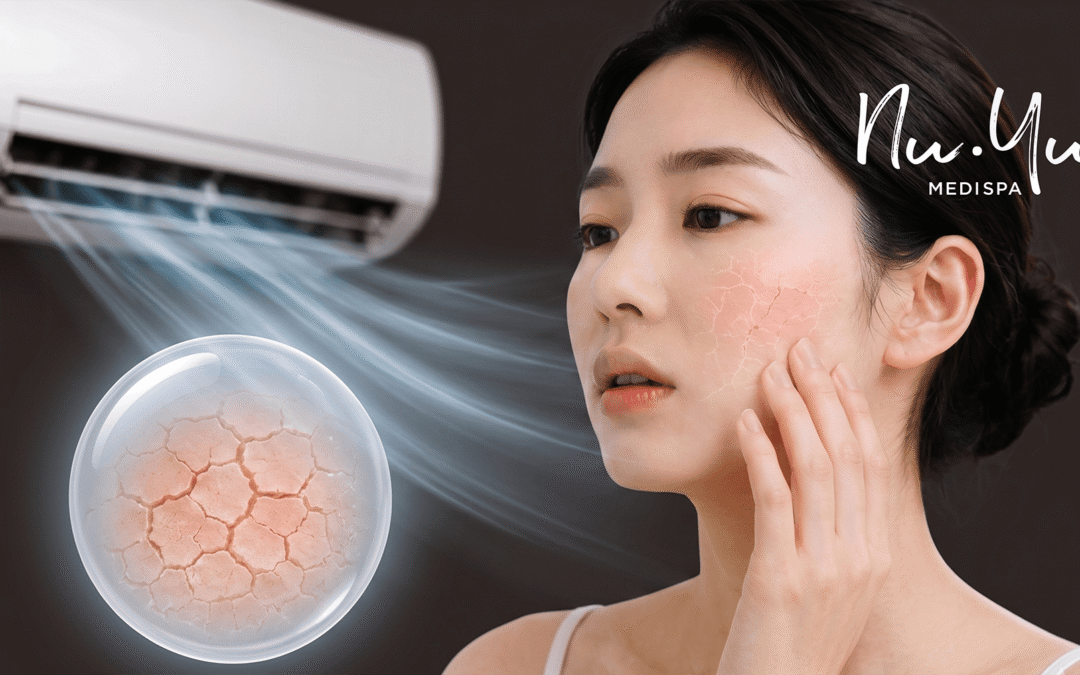
There is a specific kind of skin frustration that almost everyone living in Qatar develops over the course of a summer, and it tends to arrive quietly. Your skin starts feeling tight despite the moisturizer you apply every morning. A dullness sets in that does not seem to respond to anything. You notice more breakouts than usual, even though you are not doing anything differently. Products that worked well through winter suddenly feel either too heavy or completely ineffective.
Most people assume this is caused by the heat outside. The heat is part of it. But the more significant driver for most residents of Doha is something they spend far more time in than outdoors: the air conditioning.
Understanding what prolonged air conditioning does to the skin at a biological level explains why summer skincare in Qatar requires a different approach from any other climate on earth, and why treatments focused on hydration and barrier repair become so important during these months.
The Physics of What Air Conditioning Does
Air conditioning systems cool indoor air by passing it over cold refrigerant coils. As part of this cooling process, they extract moisture from the air. The result is an indoor environment with a relative humidity between 30 and 45 percent, sometimes lower in very cold offices or hotel lobbies. Outdoor humidity in Doha in July typically ranges from 60 to 85 percent.
This means that every time a person in Doha moves from the outside to the inside, their skin transitions from an extremely humid environment to an extremely dry one within seconds. This happens multiple times a day: home to car, car to office, office to restaurant, restaurant to car, car to home. Each transition is a humidity shock to the skin’s surface layer.
The physical consequence of low-humidity air in contact with skin is straightforward. The skin’s outermost layer, the stratum corneum, normally maintains its own moisture content partly through ambient humidity and partly through moisture pushed up from deeper skin layers. When ambient humidity drops significantly, the dry air acts as a passive desiccant, pulling water out of the stratum corneum through a process called transepidermal water loss, or TEWL. The air takes what it needs, and the skin loses what it had.
Published research on skin behavior in air-conditioned environments has confirmed measurable decreases in stratum corneum water content and alterations in skin elasticity within as little as two hours of exposure to low-humidity conditioned air.
What the Skin Barrier Is and Why This Matters
The stratum corneum is not just a layer of dead skin cells waiting to be shed. It is a precisely organized structure that functions as the body’s first line of defense against environmental damage, water loss, and pathogen entry. It is composed of those flattened dead cells, called corneocytes, arranged like bricks, bound together by a mortar of lipids that includes ceramides, cholesterol, and free fatty acids.
Ceramides alone make up approximately 50 percent of the lipid composition in the stratum corneum and are primarily responsible for maintaining the tight junctions between cells that prevent water from escaping. When ceramide levels drop or when the lipid organization in the stratum corneum is disrupted, the barrier loses integrity. Water escapes more readily. Irritants, allergens, and microbes enter more easily.
This is what repeated daily exposure to air conditioning does to the skin over weeks and months in Qatar’s summer. It does not cause a dramatic, immediate event. It causes a slow, cumulative degradation of barrier function that manifests as a cluster of frustrations described above: dullness, tightness, increased sensitivity, inconsistent behavior, and, in many cases, a worsening of existing conditions such as eczema or rosacea.
The Dehydration and Oil Paradox
One of the most confusing aspects of AC-related skin problems in Qatar is that they frequently affect people who would describe their skin as oily rather than dry. This seems counterintuitive, but it follows a well-understood physiological logic.
When the skin barrier is compromised and water loss accelerates, the skin’s sebaceous glands respond by increasing oil production. The body is attempting to compensate for what it perceives as a compromised surface by adding more lipid output. The result is skin that feels greasy or looks shiny on the surface while simultaneously being dehydrated in the layers beneath. Products feel heavy and sit on top rather than absorbing. Pores become more congested because sebum mixes with dead skin cell buildup, which accumulates faster under disrupted barrier conditions.
This is called dehydrated-oily skin, and it is extremely common among people in Doha during peak summer. It responds poorly to treatments designed for dry skin and equally poorly to those designed for oily skin, because neither addresses the actual problem: a barrier in need of repair and deeper hydration than surface products can easily reach.
The Temperature Shock Effect
Beyond the humidity issue, the temperature contrast itself adds another layer of stress on the skin.
Stepping from 44°C outdoor heat into a space chilled to 20 or 22°C creates an instant thermal shock to the skin surface. Blood vessels, which dilate in heat to help regulate body temperature, suddenly constrict. Sebum, which flows more freely in heat, cools and solidifies faster in pores. The skin’s natural rhythm of activity is interrupted multiple times throughout the day.
Over time, this repeated thermal cycling stresses the microvascular network in the skin, contributes to the appearance of enlarged pores, and can worsen conditions like rosacea, where vascular reactivity is already elevated. The skin essentially never settles into a stable environmental state during a Doha summer if you move regularly between outdoor and heavily air-conditioned spaces.
Signs Your Skin Is Struggling With AC Exposure
It is worth being specific about what a compromised skin barrier looks like in practice, because many of these signs are mistaken for other causes.
Tightness after cleansing that lasts longer than a few minutes or persists even after moisturizer application is a direct indicator of TEWL and reduced barrier water content.
Skin that has suddenly become reactive to products it previously tolerated indicates a barrier disruption. The barrier is no longer filtering out potentially irritating ingredients, so things that once sat harmlessly on the surface are now triggering reactions.
Flakiness around the nose, corners of the mouth, and cheeks, despite regular moisturizing, is a sign that the skin barrier is shedding compromised cells faster than the skin can replace them.
Increased breakouts without a dietary or hormonal explanation, particularly around the cheeks and jawline, often reflect increased congestion from the dehydration-driven oil overproduction described above.
Skin that looks flat, grey, or lacks the natural luminosity it had during less stressful months reflects reduced hydration in the deeper skin layers, where plumpness and light refraction are generated.
What Actually Helps: At Home
Addressing the AC-skin problem at home requires thinking about both barrier repair and hydration, in that order.
Barrier repair comes first because putting more hydrating products onto a compromised barrier is only partially effective. Without an intact lipid structure between the cells, water added to the skin surface escapes almost as fast as it is applied. Ceramide-containing products are the most clinically supported approach to topical barrier repair, because ceramides are identical to the lipids naturally present in the stratum corneum and can integrate into the existing structure to repair gaps. Research published in the Journal of Dermatology found that ceramide-containing formulations can restore measurable barrier function within seven days of consistent use.
For hydration, hyaluronic acid serums are widely used but deserve a specific note for Qatar’s climate. In environments with relative humidity below approximately 40 to 50 percent, which is common indoors in air-conditioned Doha spaces, hyaluronic acid applied to the skin surface can actually draw water upward from deeper skin layers toward the surface, where it then evaporates, temporarily worsening dehydration. The solution is always to apply hyaluronic acid while the skin is still slightly damp, and to immediately seal it with a moisturizer containing occlusive ingredients such as glycerin, squalane, or a ceramide cream. This traps the moisture before it escapes.
Niacinamide is another ingredient worth prioritizing in a summer routine in Qatar. It directly supports ceramide synthesis in the skin, reduces sebum production in dehydrated-oily skin, and strengthens the barrier over time. It is also anti-inflammatory, which matters when the barrier is compromised and more reactive.
Avoiding over-cleansing and over-exfoliating is equally important. The instinct to cleanse more frequently in summer to manage oiliness and sweat is understandable, but harsh cleansers and aggressive exfoliation further strip the already-stressed barrier lipids. A gentle, pH-balanced cleanser used twice daily is typically enough.
When At-Home Care Is Not Enough
For many people in Qatar, especially those who have spent multiple summers here, the cumulative damage to the skin barrier from repeated AC exposure has reached a point where topical products alone are working too slowly.
This is where in-clinic treatments provide a meaningful advantage. They address the skin’s condition at a depth and efficiency that cannot be replicated by surface-applied products, and they work in sessions rather than over weeks of consistent use.
At Nu Yu MediSpa in Doha, the most relevant treatments for AC-related skin barrier damage and dehydration during summer are the following.
HydraFacial
The HydraFacial treatment is particularly well-suited to the combined congestion and dehydration profile that AC-affected skin presents in Qatar’s summer. The extraction steps physically clear the congestion accumulated from dehydration-driven oil overproduction, while the serum infusion delivers hyaluronic acid, antioxidants, and peptides into freshly cleared, receptive skin. The immediate result is cleaner, more hydrated, and more luminous skin. The cumulative result of monthly sessions through the summer is a progressively healthier barrier that becomes less reactive and better able to manage the ongoing environmental stress.
You can find full details of Nu Yu’s face treatments in Doha, including HydraFacial options and available boosters.
Skin Booster Injections
For clients whose barrier has been compromised to the point that surface treatments are not keeping pace, skin boosters deliver concentrated hyaluronic acid directly into the dermis via micro-injections. Unlike topical application, which is limited by the skin’s surface permeability, injected hyaluronic acid integrates into the dermal layer, where it binds water and supports the skin’s structural hydration from within. The results are typically visible within a week and last several months, providing a foundation of deep hydration that topical products can then maintain at the surface level.
Barrier Repair Facial Protocols
Beyond the HydraFacial, targeted facial protocols using medical-grade calming and barrier-repairing actives can be prescribed for clients whose skin has become sensitized or reactive due to AC-related disruption. These are particularly relevant for clients with conditions such as rosacea or eczema that have worsened during the summer, or for clients whose skin has become so reactive that standard product application causes discomfort.
The team at Nu Yu MediSpa will assess your skin’s current barrier status and recommend an appropriate starting point, rather than applying a standardized protocol that may not match what your skin actually needs at that moment.
A Practical Daily Approach for Life in Doha
For anyone spending significant time in air-conditioned environments in Qatar, a few adjustments to the daily routine make a measurable difference to how the skin holds up through summer.
In the morning, cleanse gently, apply a niacinamide serum to damp skin, follow with a ceramide-containing moisturizer while the serum is still slightly wet, and finish with SPF 50. This sequence supports barrier function, locks in surface hydration, and protects against unavoidable UV exposure even during brief outdoor time.
During the day, if you are in heavily air-conditioned spaces for more than a few hours, a fine-mist spray applied over makeup or bare skin helps top up the surface moisture that the AC is continuously removing. This is a minor step, but one that makes a noticeable difference in how skin looks and feels by late afternoon.
At night, the skin undergoes its primary repair cycle. A richer ceramide or barrier-focused cream applied before sleep, when the body’s regenerative activity is highest, is significantly more effective than the same product applied in the morning. The skin is neither actively losing moisture to AC air nor fighting UV, giving the barrier-repair actives the most favorable conditions to work.
Drinking adequate water throughout the day supports hydration from within, though it is worth noting that systemic hydration and skin hydration are not the same thing. Drinking water helps maintain healthy internal organ function, but does not directly resolve barrier dysfunction. The two approaches, internal hydration and topical barrier repair, are complementary rather than interchangeable.
Frequently Asked Questions
Is my skin getting drier because of the heat or the AC?
Both contribute, but the air conditioning is typically the primary driver of barrier dehydration for people who spend most of their day indoors in Qatar. The heat outdoors contributes to congestion and UV damage, while the dry AC air continuously strips moisture from the skin throughout the day.
Why do my skincare products stop working in summer?
When the skin barrier is compromised, its permeability changes. Some products that previously sat comfortably on an intact barrier are now penetrating more deeply and triggering reactions. Others that relied on normal barrier function to retain moisture are no longer effective because the barrier itself is not retaining what it delivers. The products have not changed; the skin’s ability to respond to them has.
Can I use the same moisturizer in summer as in winter?
In Qatar, the answer is usually no. The barrier stress is significantly higher in summer due to AC exposure, and a winter moisturizer that was sufficient for barrier maintenance may not be enough for summer repair. A ceramide-rich, barrier-focused formulation is more appropriate from May through September.
How long does it take to repair a compromised skin barrier?
With the right products applied consistently, measurable improvement in barrier performance can occur within 1 to 2 weeks. Clinical studies on ceramide formulations have demonstrated significant recovery in as little as seven days. In-clinic treatments accelerate this timeline considerably.
Should I cut back on exfoliation in summer?
Yes, if your skin barrier is already showing signs of stress. Exfoliation removes the very lipid layer that the barrier needs to maintain itself. A light chemical exfoliant once a week is typically the upper limit for someone dealing with AC-related barrier compromise in Doha during summer.
Book Your Skin Assessment at Nu Yu MediSpa Qatar
If your skin has been struggling through Qatar’s summer in a way that home care alone is not resolving, a skin assessment at Nu Yu MediSpa gives you a clear picture of what is happening and the most effective way to address it.
The team at Nu Yu MediSpa Doha works with all skin types and backgrounds, and they will build a plan around what your skin specifically needs right now, not a generalized summer protocol.