
Introduction
Qatar’s UV index reaches 11 in May and stays there through June and July — a level classified as extreme, with a burn time of just 10 minutes on unprotected skin. That single fact explains why timing matters so much when planning laser hair removal in Doha.
The treatment itself is straightforward. A concentrated beam of light targets the melanin inside each hair follicle, converts to heat, and damages the follicle’s ability to regrow hair. Done properly and with the right laser for your skin tone, it is safe, effective, and long-lasting. But laser hair removal works in a series of sessions spaced weeks apart, and it temporarily makes the skin more photosensitive after each session.
Starting in May means you finish your course before Qatar’s harshest sun months. Starting in June or July means managing sun avoidance in conditions that make that genuinely difficult.
This article covers everything you need to know before booking: how the treatment works, how many sessions you need by body area, what your skin type means for safety and results, and exactly what to do before and after each session to protect your skin in Qatar’s climate.
Why Laser Works in Multiple Sessions, Not One
Laser hair removal does not work in a single session because hair does not all grow at the same time.
Every follicle on your body moves through three phases: the anagen (active growth) phase, the catagen (transition) phase, and the telogen (resting) phase. The laser can damage a follicle only during the anagen phase, when the hair is actively growing and melanin-rich. At any given moment, only a fraction of your follicles are in that phase, roughly 20% on the legs, with higher percentages in other areas.
This is why a single session reduces hair noticeably but never completely. Each subsequent session catches the follicles that were resting or transitioning during the previous one. Sessions are spaced according to each body area’s growth cycle to maximize the number of active follicles targeted each time.
How Many Sessions Do You Need?
Most people need between 6 and 8 sessions for a significant, long-term reduction across most body areas. Hormonal areas like the face, underarms, and bikini line can require more, often 8 to 12 sessions, because hormonal fluctuations keep pushing follicles back into active growth.
Session spacing depends on the area:
- Facial areas: every 4 to 6 weeks
- Body areas (legs, arms, back, abdomen): every 6 to 8 weeks
| Body Area | Approximate Sessions Needed | Interval Between Sessions |
| Upper lip/chin | 8–10 sessions | 4–6 weeks |
| Full face | 8–10 sessions | 4–6 weeks |
| Underarms | 6–8 sessions | 4–6 weeks |
| Bikini / Brazilian | 6–8 sessions | 4–6 weeks |
| Full arms | 6–8 sessions | 6–8 weeks |
| Full legs | 6–10 sessions | 6–8 weeks |
| Back / chest | 8–10 sessions | 6–8 weeks |
Starting with 6 to 8 sessions spaced over 6 to 8 weeks means a full course for body areas takes roughly 9 to 14 months from first to last session. Most clients in Qatar who start in May will complete the bulk of their sessions within the year, with maintenance appointments extending into the following spring if needed.
After completing an initial course, maintenance sessions are recommended every few months, gradually extending to every 6 to 8 months as regrowth slows.
Skin Types and Safety: The Fitzpatrick Scale
The most common concern among clients in Qatar is whether the laser is safe for their skin tone. The answer is yes, when the right laser is used.
The Fitzpatrick scale categorizes skin into six types based on pigment level and how skin responds to UV light. Types I to III cover fair to medium skin. Types IV to VI cover olive, brown, and dark skin, which are the most common among clients in Qatar and the wider GCC.
The risk with darker skin types is not the laser itself but the laser wavelength. Shorter wavelengths, such as Alexandrite at 755nm, are highly effective on fair skin but can absorb too much energy in the epidermal melanin of darker skin, increasing the risk of burns or post-inflammatory hyperpigmentation. Longer wavelengths, particularly the Nd: YAG at 1064nm, bypass the epidermal melanin layer and deliver energy deeper into the follicle, where it is needed, with significantly less surface risk.
The Soprano Titanium Advantage for Qatar’s Client Profile
At Nu Yu Medispa Qatar, laser hair removal is performed using the Soprano Titanium, a medical-grade system by Alma Lasers. Soprano Titanium is widely regarded as one of the safest options for the range of skin tones found across Qatar and the GCC.
It combines three wavelengths simultaneously: 755nm Alexandrite, 810nm Diode, and 1064nm Nd: YAG. Instead of delivering a single high-energy pulse, which carries a higher risk on melanin-rich skin, Soprano Titanium uses SHR (Super Hair Removal) technology to gradually heat the follicle to the required temperature across multiple low-energy passes. This gradual heating approach is safer for all skin types, including Fitzpatrick types V and VI, which cover most Arabic, South Asian, and African skin tones.
The system also incorporates IcePlus continuous cooling, which keeps the skin surface cold throughout the session while maintaining the target heat deep in the dermis. This combination makes the treatment virtually painless while protecting the outer layer of skin from heat damage.
A critical advantage for clients in Qatar: Soprano Titanium can also be performed on tanned skin and, in many cases, year-round. This does not mean sun protection before and after sessions is less important; it means the laser’s safety margin is wider than that of older single-wavelength systems.
Laser and Sun Exposure in Qatar’s Climate
Doha’s UV index hits 11 in both May and June, an extreme level with peak intensity between 10 am and 2 pm. Even during early morning and late afternoon hours, UV exposure remains substantial from February through September.
This context makes the timing of laser sessions more consequential in Qatar than in many other countries.
Laser hair removal increases photosensitivity in the treated area for several days following each session. Sun exposure on freshly treated skin raises the risk of hyperpigmentation, uneven tone, and, in rare cases, burns.
The standard guidance is:
- Avoid direct sun exposure for at least 48 hours before and after each session
- Apply broad-spectrum SPF 50 on treated areas that are exposed to daylight, starting from the first session and continuing throughout the course
- Avoid waxing, plucking, or any other root-removal method for at least 4 to 6 weeks before treatment; the follicle needs to be present for the laser to target it
- Shave the area to be treated 24 to 48 hours before the appointment
- Avoid heavy perfume, deodorant, or topical products on the treatment area on the day of the session[^13]
For clients in Qatar having sessions during the summer months, wearing protective clothing that covers treated areas during peak UV hours is a practical, easy way to comply with post-treatment sun guidance without significantly changing daily routines.
What Happens During a Session at Nu Yu
At Nu Yu Medispa Qatar, every laser hair removal course begins with a consultation and a skin type assessment. This is not a formality; the laser settings for a Fitzpatrick type III client are different from those for a type V client, and getting this right determines both safety and effectiveness.
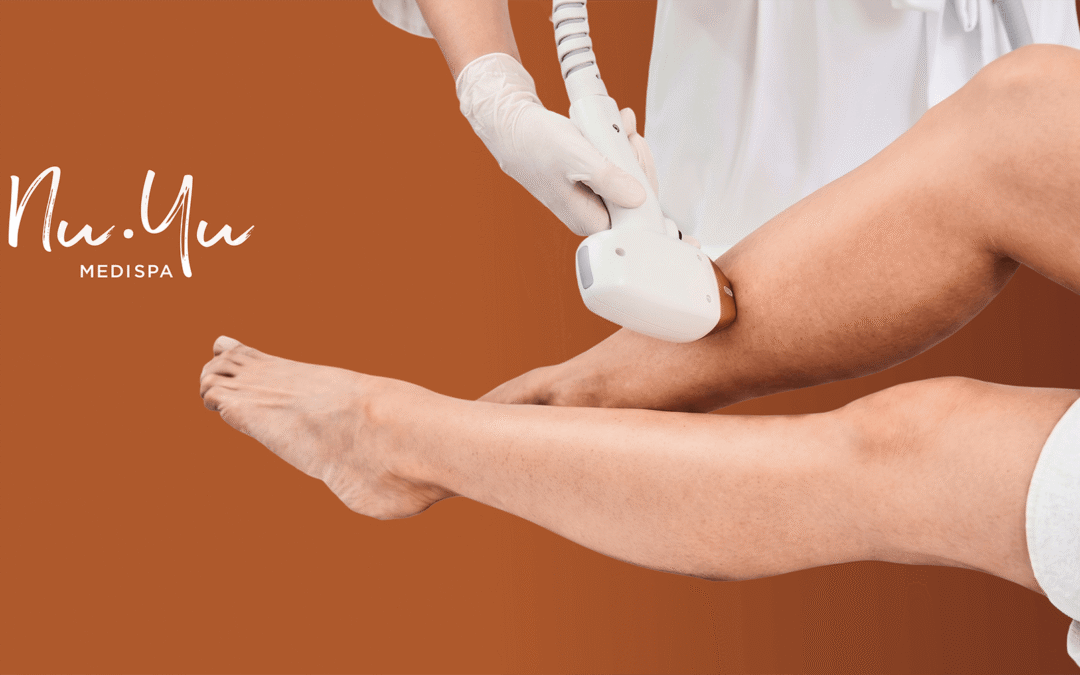
During the session itself, the Soprano Titanium applicator moves across the skin in a slow, sweeping motion, delivering SHR energy in continuous passes rather than individual pulses. The IcePlus cooling tip maintains contact with the skin throughout, so most clients describe the sensation as a warm, gliding feeling rather than the sharp snap associated with older laser systems.
After the session, mild redness or warmth in the treated area is normal and typically resolves within a few hours. There is no downtime. Clients return to work, exercise, or normal activity the same day, with only the sun-avoidance guidance above to follow.
Hair in the treated area sheds gradually over the two to three weeks following each session. This is the laser working as expected, the shed hair is not regrowth, it is the damaged follicle releasing the hair shaft.
Building Your Session Schedule Before Summer
May is the last window to start a full course and complete the first four to five sessions before peak summer heat in Qatar.
Here is what a practical schedule looks like for a client starting in May, targeting body areas on a 6-week spacing:
- Session 1: May (now)
- Session 2: mid-June
- Session 3: late July
- Session 4: early September
- Session 5: mid-October
- Session 6: late November or December
This spacing works well. The early sessions in May and June are done before Qatar’s heat and humidity peak. The gap through July and August is when sessions can be managed with proper sun protection. By September, conditions begin to ease, and the remaining sessions are completed with minimal sun management required.
For facial areas with 4- to 6-week spacing, the same logic applies, but with a session count that ends later in the year.
Clients who want to target both face and body simultaneously can do so; both areas are assessed and treated separately, and sessions are often scheduled on the same visit where timing allows.
Who Is a Good Candidate
Laser hair removal with Soprano Titanium at Nu Yu Medispa is suitable for most adults, including:
- All Fitzpatrick skin types I to VI
- Both women and men
- Clients with dark, coarse hair (responds fastest)
- Clients with olive or brown skin are common across the GCC (addressed safely with the Nd:YAG and SHR approach)
- Clients with hormonal hair concerns, including those with PCOS (more sessions may be required)
It is not recommended during pregnancy. Clients with certain skin conditions or who are on photosensitizing medications should disclose this at consultation so the team can adjust settings or timing accordingly.
Frequently Asked Questions
Does laser hair removal hurt?
Soprano Titanium uses SHR technology and continuous IcePlus cooling, making it virtually painless. Most clients describe a warm gliding sensation with no sharp discomfort.
Can I do laser in the summer in Qatar?
With Soprano Titanium, yes — the technology is designed for year-round use, including on tanned skin. The key is consistent SPF use on treated areas and avoiding deliberate tanning for 48 hours before and after sessions.
How long before I see results?
Most clients notice a visible reduction after the second or third session. Significant, long-term reduction typically appears after sessions four to six.
Is it permanent?
Laser hair removal produces long-term hair reduction, not always complete permanent removal. Most clients see an 80-90% reduction after a full course and manage any minimal regrowth with occasional maintenance sessions.
What areas can be treated?
At Nu Yu Medispa Qatar, laser hair removal is available for the face, underarms, arms, legs, bikini line, back, chest, and abdomen. Full-body sessions are also available.
Is it safe for darker skin?
Yes. The Soprano Titanium’s Nd: YAG component and SHR gradual-heating method are specifically validated for Fitzpatrick types IV through VI. A skin assessment is always performed before the first session to calibrate settings appropriately.
Book Your Consultation at Nu Yu Medispa Qatar
May is the practical window. Starting now means completing your sessions on schedule and arriving at summer with skin that is already responding.
The team at Nu Yu Medispa Doha will assess your skin type, recommend the right treatment plan for your areas and goals, and walk you through what to expect at every stage.